| INDEX | 1300-1599 | 1600s | 1700s | 1800s | 1900s | CROSS-ERA | ETHNO | |
| MISCELLANY | CONTACT | SEARCH | 
|
 Empire
Dress
Empire
DressTo be honest, I don't really like Empire fashion - I've never liked anything that didn't have its waist where it belonged, not even as a kid. Still, my friends are all for it, and I'll be damned if I don't accompany them suitably garbed on non-Rococo outings.
So, my Empire project entailed a corset, pattern provided by The Mantua Maker, as my body requires some - ahem - support. The pattern comes with good instructions, but when cutting the bust gussets, choose one size smaller than your bra. I usually wear cup B, chose B, and found it slightly too large. I also find it a bit too long, being somewhat uncomfortable when I sit. Contrary to the instructions, I had to put in quite a few strips of plastic boning to keep the breast part from drooping. The pattern unfortunately doesn't give any hints on their placement, so I simply put them next to seams where possible, and in strategic places of the front. Pictures will follow.
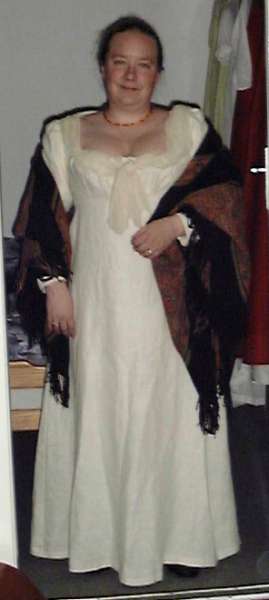
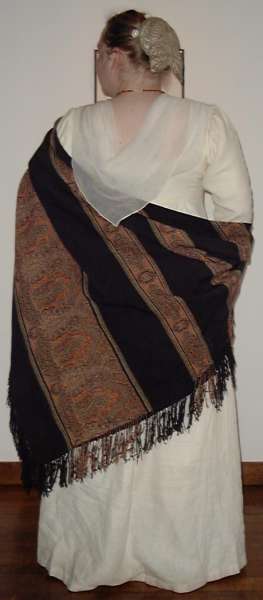
The dress itself is made of ecru linen (2.5m @150, and that was a close shave) and pieced together from various patterns: The pattern of the bodice is based on a Dutch dress, the skirt on skirt pattern "A" in Hunnisett, minus the train (as it will mainly be worn outdoors), and the sleeves on the ones of the c. 1806-09 one on p. 48 of the 1995 Macmillan Arnold edition. I adjusted the sleeve head somewhat. It had to be long sleeves because (a) my upper arms are very sensitive of cold and (b) to cover a tattoo on one forearm. Judging from the sources available, cotton muslin was more fashionable, but I had to go with what was available at shops. The only muslin-like fabrics I had at hand were either too sheer or had a slightly fluffy surface, i.e. would be prone to travelling upwards against whatever was beneath.
The dress is closed in back with hooks and eyes and a ouple of laces to keep the overlap from sticking up, flashing the hooks. There wasn't enough overlap for buttons and buttonholes, but now that I've seen thread loops used instead of buttonholes (why didn't I think of it?), I'll change the closure. From the waist down, there's simply a long slit. Here's a picture of the front and one of the back. Under it goes a short-sleeved chemise that follows the same pattern as 18th century chemises.
I had fallen in love (as much as is possible if you don't really like the style) with a dress worn with a dark blue peplos, i.e. a half-length overgown with a V neckline that opened to reveal a triangular part of the dress, like the dresses seen in a van Eyck painting - a style that I quite like. I'm not into medieval, but that is one style I could imagine myself wearing. As linen was on offer when I went to look, the fabric I chose for the peplos was also linien, a yellowish green I'd once seen on a Cashmere shawl of the era. I've used 1.5m @150 for a not quite knee-length peplos with short sleeves, and there's almost nothing left of the fabric. The pattern for the peplos is the same as for the dress, but with a different neckline, of course. I changed the sleeve pattern so that it is a bit wider and does not taper. The sleeves are slit on the outside from the hem almost to the shoulder and neatened narrowly. The slits will be held closed at intervals, similar to Renaissance-ish slit styles, but I don't know yet what with. First I'll have to attach a border to the neck and waist line.
My experiences wearing it for the first time were not very encouraging. The corset straps kept slipping off my shoulders, taking chemise and dress with them. I wouldn't make something with such a wide decolletage again - having the shoulder straps sit so far outside doesn't agree with my shoulder shape, apparently. The chemise neckline kept peeking out although I'd cut the neckline alone that of the dress.
After wearing the corset for a couple of hours, the boning on the sides of the back started to buckle and dig into me. They weren't string enough for my hollow back. I removed them and the ones at the sides, but it wasn't enough. I removed the ones to the front of the sides as well and shoved them into the front-side tunnel to strengthen the bones there. The ones in the centre back are just as bent, but since that is where my back is at its hollowest, it doesn't hurt. The corset wears well with just the bones in front, though. Those are the most important ones, anyway. Next time it'll be steel for the back and sides.
Content, layout and images of this page
and any sub-page of the domains marquise.de, contouche.de,
lumieres.de, manteau.de and costumebase.org are copyright (c) 1997-2022 by Alexa Bender. All rights
reserved. See Copyright Page.

GDPO


This work is licensed under a Creative Commons License.